Pride Pals Initiative
Opinion Piece
Sexual orientation
being shaped by
bias and unfairness
By: Fong Pek Qi
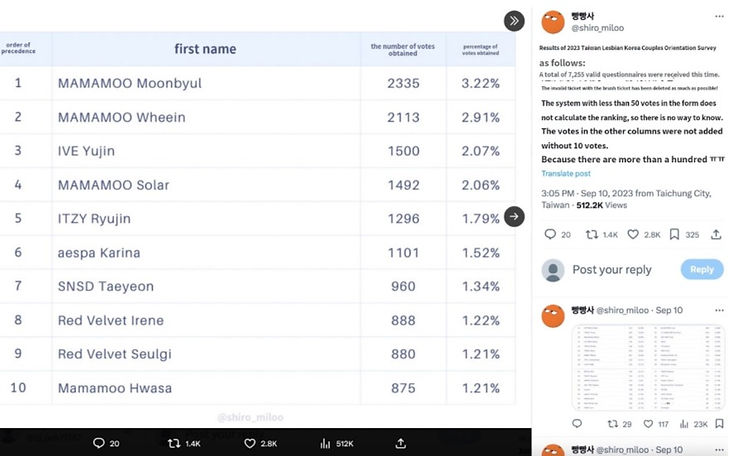
Survey results of the 2023 Taiwanese lesbian community's affection
towards Korean female idols
(Twitter: @shiro_miloo)
Recently, while scrolling through Twitter, I noticed a concerning trend: if you like a celebrity with a substantial LGBTQ+ fanbase, you are automatically assumed to be a member of the LGBTQ+ community. I believe that judging someone's sexual orientation based on their celebrity preferences is deeply problematic, and It negatively impacts both LGBTQ+ and non-LGBTQ+ fans. Therefore, it is essential to oppose and prevent the continuation of this trend.
Fans organise votes within the LGBTQ+ community on social media to select their favourite idols, ultimately creating rankings that reflect the preferences of the LGBTQ+ community. Some LGBTQ+ members use the results as a tool, attempting to guess whether individuals around them are part of the LGBTQ+ community based on their preferences for specific idols.
In the recent survey measuring the Taiwanese lesbian community's preferences towards Korean female idols in 2023, two Mamamoo members secured the first and second positions with significant votes. Surveys like this give an excuse for the public to label all Mamamoo fans as exclusively "lesbian". In response, @WHEESUNATION, a Mamamoo fan, shared her thoughts on Twitter, expressing her sadness about such assumptions and suggesting that using the phrase "some of them" would be more appropriate. This highlights that using celebrity preferences to determine someone's sexual orientation is a sweeping and offensive behaviour.

A statement written by a Mamamoo’s fan on Twitter.
(Twitter: @WHEESUNATION)
As independent individuals, our celebrity preferences are uniquely shaped by factors such as personal music taste, celebrities' personalities, appearances, or talents. The choice to admire a particular celebrity is a subjective decision, not inherently linked to one's sexual orientation. However, some members of the LGBTQ+ community might unintentionally assess the sexual orientation of others based on their celebrity choices, leading to misjudgments. Understanding the distinctions between sexual orientation and personal preferences is crucial to prevent misunderstandings, as judgments based on such illogical assumptions are inaccurate and one-sided.

A statement written by a Mamamoo’s fan on Twitter.
(Twitter: @Jennifer920506)
This trend might not only affect non-LGBTQ individuals but also has an impact on LGBTQ+ individuals. People's speculations stemming from illogical stereotypes might lead to unnecessary stress and anxiety for the LGBTQ+ community, particularly for those who are unprepared to discuss their orientation openly. @Jennifer920506 mentioned that, when others learn about her liking for Mamamoo, she feels pressure as she worries people might discern her LGBTQ identity. Due to the influence of this trend, It turns out that some people may feel compelled to reveal their sexual orientation even though they are unwilling to do so.
The disclosure of one's sexual orientation should be voluntary rather than being forced by external pressures. Some individuals choose to keep their favourite celebrities hidden due to the fear of judgement, which could result in feelings of isolation. Thus, there should not be an overwhelming reaction when discovering that someone admires a celebrity with a largely LGBTQ+ fanbase. Refraining from making unfounded assumptions fosters a more inclusive environment for both LGBTQ+ and non-LGBTQ+ individuals, allowing everyone to express their preferences comfortably without feeling pressured to disclose personal details.

A statement written by a netizen on Twitter.
(Twitter: @VespersDante)
On the internet, many people tend to view fan communities of certain celebrities through biased lenses. @VespersDante, for instance, expressed his enjoyment of Taylor Swift's music but distanced himself from being a fan, suggesting that only gay individuals appreciate pop girls. These comments not only indicate the presence of the trend of judging someone's sexual orientation based on their celebrity preferences but also make non-gay fans feel uncomfortable.

A statement written by a Taylor Swift’s fan on Twitter.
(Twitter: @seven_byTS)
Taylor Swift’s fan @seven_byTS is a good example, he faced discomfort as people often assume that every male fan of Taylor Swift is gay. This speculation has led to unpleasant experiences for him; he expressed dissatisfaction and even suggested checking the sexual orientation of a celebrity's fans before becoming a fan. It's evident that many individuals are adversely affected by this trend and efforts should be made to stop its spread.

A statement written by a Ryan Reynold’s fan on Twitter.
(Twitter: @SwagMuffin1002)
Fans of Ryan Reynolds sometimes find themselves in similar situations. When @SwagMuffin1002 expressed his admiration for Ryan Reynolds on Twitter, he was wrongly assumed to be gay, leading to frustration. Setting aside the logical flaws and credibility issues of using celebrity choices to judge someone's sexual orientation, it is essential to recognize that sexual orientation is essentially a private matter for each individual. Connecting someone's sexual orientation with their celebrity preferences is comparable to intruding into their personal space without consent, constituting an offensive behaviour. Instead, we should take a more respectful and considerate approach, understanding that individuals have the right to keep parts of their personal lives private, especially topics as intimate as sexual orientation.
Inclusivity is indispensable in our society. Creating an environment that fosters inclusivity means acknowledging and appreciating each individual's distinct characteristics. Jumping to conclusions about someone's sexual orientation because they admire a celebrity denies them the fairness and respect they deserve. It is crucial to foster a mindset that values diversity and understands that personal preferences and orientations are complicated and should not be assumed. By addressing these preconceptions, we may create a more open and accepting society where individuals can freely pursue their passions without being restricted by public expectations and without unfounded assumptions about their personal lives.
In conclusion, the trend of assuming one's sexual orientation based on celebrity adoration is deeply problematic. We need to take a step back and reflect on why this trend is problematic and how it affects individuals. We must challenge this trend, respect people's privacy, and advocate for an environment that encourages diversity. Our shared goal should be a more accepting world, free from the constraints of harmful stereotypes. Let us collectively work towards creating an environment where people can express themselves without judgement and assumptions about their identity.