Academic Apartheid?
Investigating the CGPA-Driven Social Dynamics in Taylor's College and University
Thursday, 23 Nov 2023, 8.45 PM MYT
By Fong Pek Qi, Toh Yong Jie, Teo Shi Eng
In the increasingly competitive environment of universities, students constantly strive to achieve high grades and maintain a solid academic record. This emphasis on academic performance has led to a growing trend among students to consider their potential group members' CGPA (Cumulative Grade Point Average) before forming groups for collaborative assignments. CGPA is often used to measure a student's performance in a program and can be an indicator of their academic achievement and performance. Some students with high CGPAs often exhibit strong academic commitment and excellent learning abilities. Thus, they are more likely to work with high-CGPA peers to enhance overall group performance.
Students doing group assignment.
(Photo credit: taken by Teo Shi Eng)
Lecturer Alshaimaaa Alanadoly from School of Fashion Design said this trend is really happening among the students.
“They (good students) often stick together to make sure that they will achieve the best outcome for their assignments,” she said, adding that this scenario may not be entirely beneficial for the students.
“It’s not so beneficial because weaker students will be left together, and they will not learn from the high achievers. This will lead to a wide gap between these two groups of students,” she added.
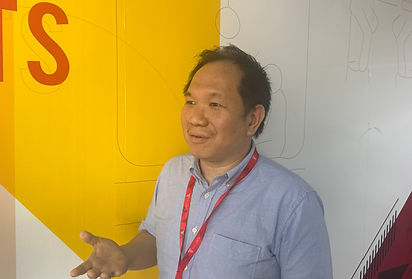
Foundation in Business Programme Director, Winston Lim, said he had noticed this scenario between the students when forming assignment groups. However, he thinks that it's not so much a matter of CGPA.
“It's more like people want to be in groups with group members that can resonate with them and have the same values as those facing importance in education,” he added.
Photo of Mr Winston Lim talking about this issue.
(Photo credit: taken by Hiew Sui Kee)
From the lecturers' perspective, the practice of prioritising CGPA in group formation is both fair and unfair. On the one hand, they understand the students' desire to collaborate with peers of similar academic standing in order to improve their chances of success. But they also recognise that this practice can lead to discrimination against students with lower CGPAs, potentially limiting their learning opportunities.
"It is two-sided," remarked Ms Alshaimaaa Alanadoly.
“It has a high tendency to lead to discrimination, it shouldn't but I understand where the students are coming from, they also just want to safeguard the quality of assignment,” said Winston Lim.
Echoing the sentiments expressed by the lecturers, some Taylor's students acknowledge that they prioritize CGPA when selecting teammates for group projects.
Ling Rong, an 18-year-old Foundation in Art student said, “I do really consider a potential teammate's academic performance, to some extent, as it can impact the project's success.”
She also stated that she might favour individuals with higher CGPAs because she believes they have a strong work ethic and a good understanding of the subject matter, which will influence the outcome of the assignment.
This statement highlights this prevalent trend is motivated by a desire to maximise success by collaborating with individuals who have consistently demonstrated academic excellence.
However, other students had expressed reservations about this approach, raising concerns about fairness and inclusivity.
Maressa Lim Zi Wei, 22, a student from Bachelor of Biomedical Science, said, “I don't think I will select my group mates based on their CGPA. I will select based on their working style if they can work well in a team and can do their work, that should be fine already.”
Another student, Nabilah Zulkafli, also mentioned she wouldn’t select her group mates based on their CGPA.
“I don't select my group mates based on their CGPA because I don't want to discriminate against some people who have low CGPA but they can work really hard,” said the 20-year-old student of international hospitality.
In summary, the trend of prioritizing CGPA in group formation is observable among students at Taylor's University. Some students believe that collaborating with high-CGPA peers enhances the quality of assignments. However, concerns about fairness and inclusivity are also raised. Ultimately, whether to prioritise CGPA or other factors when forming groups remains a personal choice.